Before the Modern Council: A Short History of Local Deliberation
Local deliberation developed through assemblies, custom and written records. Learn how these practices shaped public decisions and the councils that followed.
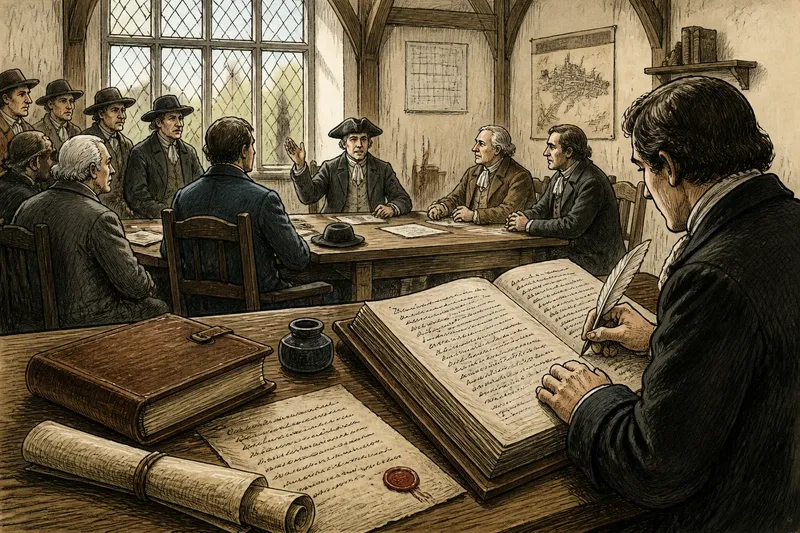
Why did local deliberation move from a gathering of neighbours to a council with an agenda and a clerk? In England, the records of parish meetings and borough corporations show a gradual, uneven change: recurring local business acquired regular settings, recognised procedures and a written account.
This is not a single story of progress from informal discussion to fairer government. Parish vestries, borough bodies and other local institutions had different responsibilities, and their powers changed over time. Looking at these English examples keeps the argument grounded without suggesting that every western society followed the same path.
Parish and borough
In England, the parish vestry became a place for handling some local matters, including parish responsibilities and the appointment or supervision of officers. Its role and membership varied. The word “public” did not mean that every resident had an equal right to attend, speak or decide.
Borough corporations followed a different pattern. They were formal municipal bodies, often with powers and membership defined by local arrangements or charter. A borough meeting was not simply a larger village assembly: it belonged to an institution with recognised officers and responsibilities. Parish and borough business could overlap in people’s lives while remaining distinct in law and practice.
These distinctions matter because “local assembly” can describe very different things. One gathering might advise an officeholder, another might manage a shared responsibility, and another might make decisions within a recognised body. The people affected by an outcome were not necessarily the people entitled to shape it.
Repetition and custom
Recurring business encouraged communities to meet again. Local responsibilities, disputes and appointments could not always be handled once and forgotten. When an issue returned, people needed some way to tell an accepted decision from a new proposal and to know who was responsible for carrying it out.
Custom supplied part of the answer. Participants might recognise who could summon a meeting, which officers had a role or how a decision should be announced. Repetition made these expectations familiar, though not necessarily fair. Custom can work like a well-used key: it opens a door for those who know which lock it fits, while leaving others outside.
Regular meetings also made accountability more possible. Residents could question an officer in a recognised setting if the institution allowed them to do so. Where a meeting depended entirely on the choice of a powerful individual, the opportunity to raise concerns was less secure. Recurrence gave public business a rhythm, but did not by itself widen participation.
Procedure and influence
As routines settled, some expectations became explicit procedures. A meeting might have notice, a chair, a sequence of business and a recognised way to announce decisions. Procedures helped participants understand when a discussion counted as official business, but they also shaped whose concerns could reach that point.
A rule about who could bring forward a subject could keep some matters off the agenda. A rule about attendance or voting could make a gathering open to observers but closed to decision-makers. Formality may clarify responsibility; it can also make exclusion harder to challenge by presenting a narrow practice as settled custom.
Local arrangements differed, even within England. A parish meeting and a borough corporation did not have the same constituency, powers or work. In some places, a larger gathering sat alongside a smaller group of officers who handled business between meetings. There was no uniform sequence in which one kind of assembly simply turned into another.
Minutes and memory
Written records helped a local body carry decisions beyond the people who had attended a meeting. A minute book might name officers, record a resolution or preserve an account of an obligation. Such documents could also help a body explain its business to authorities beyond the locality.
A minute is not a transcript. The clerk’s account may distinguish a resolution from discussion, but it cannot be treated as a complete record of every disagreement or view. It shows what the institution chose to preserve, and its silences should not be mistaken for proof that no debate took place.
Writing could give a decision continuity and weight. Later participants might treat a recorded rule as authoritative even when its original circumstances had changed. A record was therefore more than a memory aid: it could help define the institution’s account of its own authority.
How did local deliberation change?
Why did communities meet repeatedly?
Recurring responsibilities, disputes and appointments brought people together more than once. A regular meeting made it easier to revisit decisions and identify who was expected to act.
Did everyone have a voice?
No. Attendance, speaking and voting rights depended on local rules and practices, which could exclude people affected by decisions. To judge a gathering’s public character, look at who could participate rather than where it met.
What did written minutes change?
Minutes could preserve decisions and appointments after participants had left, making them available to later meetings. They also gave importance to the clerk’s choices about what counted as official business.
Did formal councils end informal discussion?
No. Personal conversations and local knowledge continued alongside official meetings. Procedures gave some parts of that wider civic talk a recognised status, while leaving other parts outside the record.
Records and local authority
As local institutions became more structured, their authority was tied to recognised offices and defined responsibilities. A body might appoint officers, manage a shared responsibility or communicate with a wider authority. The precise work varied, and local arrangements could persist alongside newer forms.
Representation also changed the character of decision-making. In a larger settlement, a smaller group of officers or representatives could handle business that was difficult to conduct in a general gathering. This could make administration more manageable while putting decisions further from residents who were not among that group.
Higher authorities could recognise, regulate or reorganise local bodies. That wider involvement means local institutional history cannot be explained only by what happened within a meeting room. Authority was shaped by the relationship between local custom and rules set beyond the locality.
Reading a parish record
Say you come across an invented parish minute book from an English village in the early nineteenth century. Its entries repeatedly name the same small group of officers, record decisions about parish responsibilities and rarely list attendees. Start by noting which names and duties recur; the result is a list of the people and tasks the clerk consistently records. Then compare how decisions are worded across entries; the result may show which phrases mark an agreed resolution rather than discussion. Finally, check whether attendance or the method of choosing officers is recorded. If those details are absent, the book cannot establish who took part or how selection occurred; the trade-off is that it reveals institutional routine more clearly than the full range of local opinion.
For a real record, the same questions can guide careful reading:
- Check whether the entry names the body that met; if it does, compare that name across entries to identify continuity, and if it does not, avoid assuming which institution acted.
- Check who is named as present; if a consistent group appears, treat it as evidence of recorded participation, and if no attendees are listed, do not infer that only named officers attended.
- Check whether the clerk records how officers were chosen; if a method is stated, describe only that recorded process, and if it is missing, leave the selection method unresolved.
- Check whether the text separates debate from a decision; if it does, distinguish discussion from the outcome, and if it does not, describe the wording as ambiguous rather than treating every entry as a resolution.
- Check whether a later entry refers back to an earlier decision; if it does, compare the wording to see how the institution carried it forward, and if it does not, do not assume the earlier matter remained in force.
- Check for gaps or damaged pages; if the sequence is incomplete, qualify any account of change, and if the sequence is intact, still treat the minutes as the clerk’s record rather than a full transcript.
Local deliberation did not become more legitimate merely by becoming more regular or more carefully recorded. Records can clarify who held responsibility and what a body decided, while leaving participation narrow or disagreement unrecorded. The history of local deliberation is most useful when it prompts a precise question of present institutions: who can put an issue before the meeting, and what happens to it once the minutes are written?