Reading an Agenda Before Your First Public Meeting
Reading a public meeting agenda beforehand helps you follow its order, understand unfamiliar terms and choose which items to track in the room.
What should you look for before sitting down at your first public meeting? Reading a public meeting agenda gives you a map of the room’s business: what comes when, which papers belong to each item and where your attention may be most useful. You do not need to master every acronym or read every attachment. A little preparation makes it easier to recognise what is happening while it happens.
Find the current agenda
Start with the meeting notice on the council, school board or public agency’s website. Follow the link to the agenda for the specific meeting, and check that its date, body name and location match the notice. Public bodies may post agendas alongside minutes, calendars and earlier versions; the meeting date is a simple way to avoid opening the wrong document.
Look for accompanying reports or attachments, often linked beside an agenda item or collected in a separate agenda packet. These papers may supply the detail that a short agenda line leaves out: a map, a staff memo, correspondence or a proposed policy. Keep the agenda open as your index, then open only the papers connected to the items you want to understand.
Documents can be updated, and publication practices differ between bodies. If the link is broken, the packet appears incomplete or the meeting details conflict, contact the clerk or meeting administrator and ask for the current materials. The agency’s instructions and applicable local rules govern access, participation and any changes to the published schedule.
Trace the order of business
Read the headings from top to bottom before studying the individual items. A typical agenda may begin with procedural business, move through presentations or public comment, and then list particular matters for consideration. The pattern is not universal; the useful point is to notice the sequence this body has published, rather than assume all meetings follow the same script.
Scan for where the agenda says the chair will call an item, where discussion is expected, and whether the item is listed for a hearing, report or other form of consideration. Do not infer more than the wording says. An agenda shows the planned order and stated purpose, not necessarily how long a discussion will last or what members will decide.
Pay attention to grouping. Several items may sit beneath one heading, or a single subject may appear in more than one place, such as a report followed by a separate action item. Mark the item numbers and headings as printed. That small reference will help you follow the chair’s announcements without relying on a vague memory of a topic name.
Read the verbs carefully
Agenda verbs are clues to the kind of business in front of the body. “Receive” or “review” may indicate that members are being given information; “discuss” points towards deliberation; “approve”, “adopt” or “authorise” signals that an action is being proposed. These words are useful hints, not a substitute for reading the item description and its supporting papers.
Also notice whether a line names a report, recommendation or draft document. A report may explain a subject without itself being the motion under consideration. A recommendation may set out a proposed course, while the agenda can separately identify the decision members are being asked to make. Use the papers to check who prepared the material and what question it leaves for the meeting.
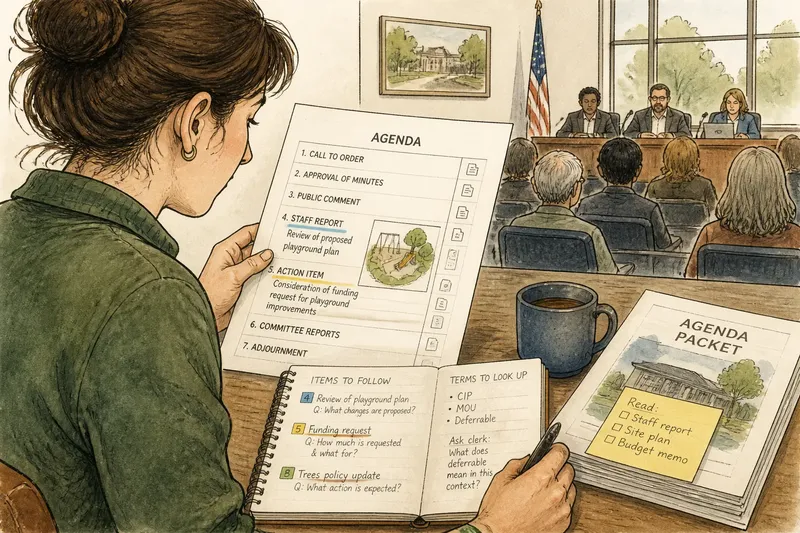
Imagine you are reading an invented agenda for a neighbourhood board. One line says “Review of proposed playground plan”, and a linked drawing shows the proposed layout. You note the item number, then see a separate later line asking members to approve a funding request. Your notes distinguish the design discussion from the funding decision, so you can follow each without assuming that the first item settles the second.
Keep an unfamiliar-terms note
Write down terms you do not recognise, along with the item number where each appears. A short note is more useful than pausing to chase every phrase as you read. Check the agenda packet first: a staff report may define an acronym, explain a procedure or identify the board, department or committee involved.
If the document uses an abbreviation without explanation, look for a glossary on the body’s website or in its meeting materials. You can also ask the clerk what the term means in that agenda. Keep a distinction between the document’s wording and your own interpretation: quote or copy the phrase accurately, then add a brief question beside it.
Some terms describe local procedures, and their meaning can depend on the body’s rules. For a first visit, it is enough to identify what you need clarified and where it appears. You are not expected to arrive already fluent in the institution’s vocabulary.
Choose a few items
Select a small number of items to follow closely. One may concern a place or service you know; another may have a linked report you can read; a third might be a matter whose stated action interests you. This is not a judgement about which business matters most. It is a manageable way to listen with care rather than trying to retain an entire packet.
For each chosen item, note the agenda number, the plain-language subject and one question you hope the meeting will answer. Questions such as “What is being proposed?”, “Which document gives the background?” or “What action is listed?” keep your attention on observable details. If the discussion answers your question, note how; if it does not, you have a precise point to check in the minutes or later materials.
Treat the agenda like a bus timetable pinned beside a route map: it helps you orient yourself, but it cannot tell you every delay or turn the journey will take. The chair may announce a change in order, defer an item or add context during the meeting. Keep the published sequence as your reference and update your notes when the room supplies new information.
Questions about agendas?
What if an agenda item is unclear?
Read its linked report and attachments, then write down the exact phrase that remains confusing. The clerk or meeting administrator may be able to explain the agenda wording or point you to the relevant public document.
Do I need to read every attachment?
No; begin with the agenda and open papers linked to the items you plan to follow. A title, report summary or map can often show which attachment is relevant to your question.
Can the agenda order change?
A chair may announce that an item will be heard at a different point, so listen for changes and note them beside the item number. The agenda remains a helpful reference even when the meeting departs from its planned sequence.
Where can I find the final record?
Look for minutes or other records on the meeting body’s website after the meeting, or ask its clerk where those documents are posted. Use the record to check what was formally recorded, rather than treating your notes as an official account.
Bring a usable page
Before leaving, reduce your preparation to one page: the meeting’s name and date, the order of business, a few item numbers, unfamiliar terms and questions to follow. Add links or document titles beside the relevant items so you can return to the source without searching again.
That page is not a script for the meeting. It is a quiet aid to attention. Reading a public meeting agenda in this way lets you recognise the business as it is called, notice when the discussion shifts and leave with clearer questions about the public record.